
Key takeaways
- A contact list is not a stakeholder map. A useful map connects each person or organization to a buying question, evidence, and a next action.
- Map three lanes separately and in a consistent order: program and mission, procurement and control, and ecosystem and influence.
- Treat roles as hypotheses until public evidence or a direct conversation confirms them; job title alone rarely proves authority.
- Early market education can be lawful and useful, but communication rules change by jurisdiction and procurement stage.
- Refresh the map as the opportunity matures, then push only the confirmed context and next actions your team needs into its CRM.
Most government account plans begin with a familiar exercise: search LinkedIn, copy an agency org chart into a spreadsheet, and color the names by seniority. The result looks like a stakeholder map. It is usually a contact list with formatting.
That distinction matters. A list can tell you that an agency has a chief information officer, a procurement director, and a program administrator. It cannot tell you who owns the problem, whether money is available, which buying path is feasible, who will use the solution, or what your seller should do on Monday morning. In public sector sales, those unanswered questions—not the absence of names—are what make an account hard to qualify.
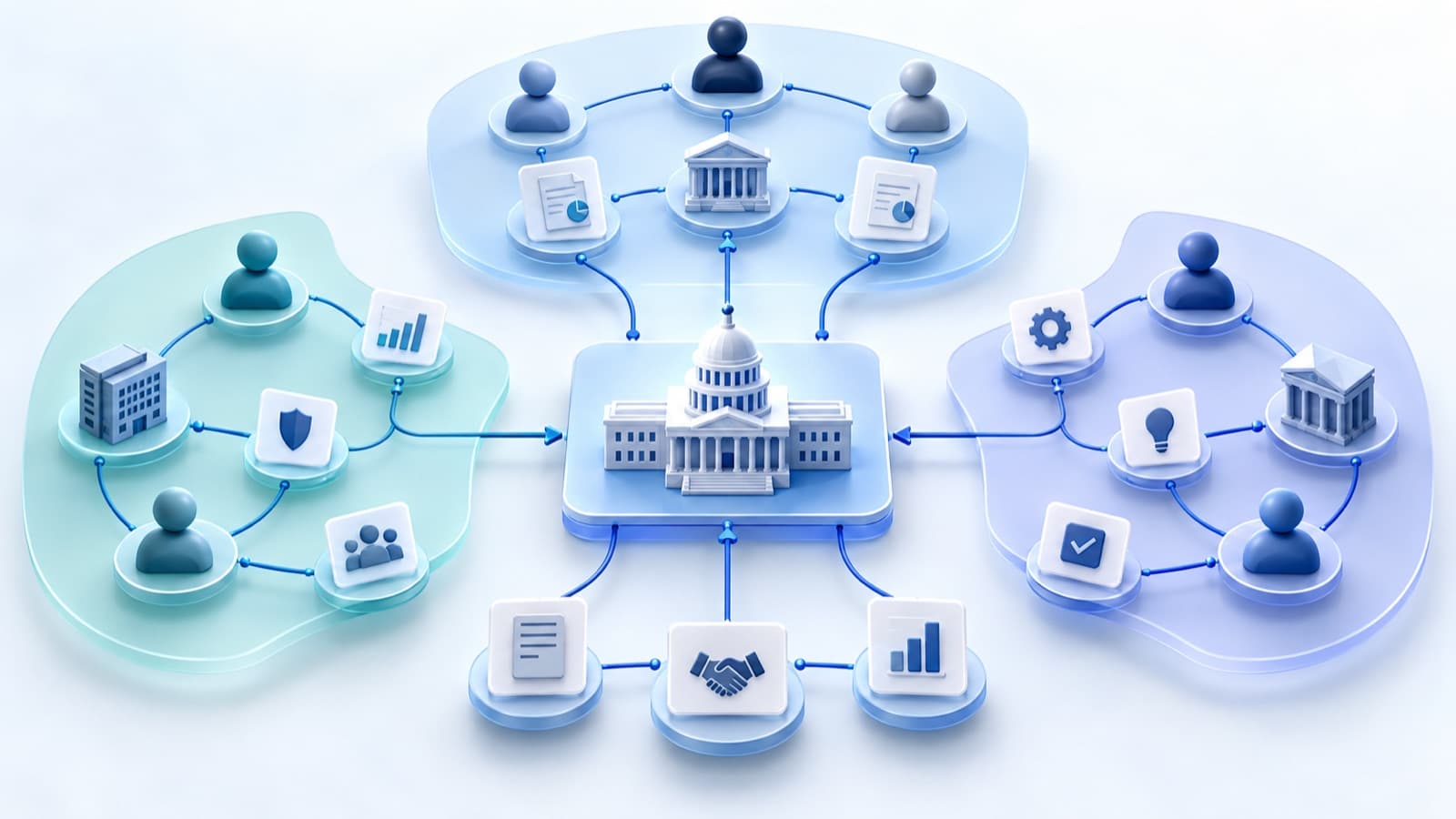
The better model is a three-lane capture map. It follows how a public need becomes a purchase across program and mission, procurement and control, and ecosystem and influence. Every entry carries evidence, a confidence level, a question, and a next action. That turns stakeholder research from a static artifact into an operating tool.
What is a government stakeholder map?
A government stakeholder map is an evidence-backed model of who shapes the need, who controls the buying process, and who can credibly inform access—each tied to an unresolved buying question and a lawful next action.
The map is not an org chart, because formal reporting lines do not describe procurement authority. It is not a relationship score, because familiarity does not prove influence. And it is not a list of people to sequence, because public purchasing rules can make a once-normal contact inappropriate after a solicitation enters a restricted phase.
A useful map answers five questions: What outcome is the agency trying to achieve? Who experiences and owns the problem? Who can authorize or fund action? What process can turn the need into a purchase? Who can provide a legitimate access path or credible evidence? If a name does not help answer one of those questions, it does not yet deserve space on the map.
The three-lane capture map template
Build the lanes separately before connecting them. This prevents a common mistake: treating the most senior visible executive as both champion, budget owner, evaluator, and procurement authority. Government decisions are distributed. One person may define the outcome, another may control the funds, a committee may evaluate, and a contracting officer may control the communication channel.
| Lane | Roles to investigate | Evidence sources | Questions to answer | Lawful access paths | Update cadence |
|---|---|---|---|---|---|
| 1. Program and mission | Program executive, department head, operational owner, budget owner, technical evaluator, administrator, frontline users, executive sponsor | Strategic plans, budgets, capital plans, legislative requests, audits, performance dashboards, meeting minutes, org charts, job postings, public presentations | Whose outcome is at risk? What is changing? How is success measured? Who must support adoption, funding, security, and implementation? | Public meetings, conferences, association events, approved discovery, RFI responses, referrals, peer education, pre-solicitation meetings when allowed | Monthly at account level; weekly once a funded initiative or active signal appears; after every substantive conversation |
| 2. Procurement and control | Contracting officer, buyer, procurement analyst, vendor-registration owner, legal or risk reviewer, security reviewer, cooperative-contract administrator | Solicitations and addenda, procurement manuals, award notices, contract repositories, vendor portals, commodity codes, board agendas, question logs, purchasing thresholds | What vehicle, authority, timeline, competition method, terms, registration, security review, and communication rules apply? | Designated solicitation contact, vendor outreach events, public procurement office hours, published Q&A, industry days, RFIs, cooperative or reseller channel when permitted | Monthly for target accounts; weekly pre-solicitation; immediately after any notice, addendum, or deadline change |
| 3. Ecosystem and influence | Incumbents, implementation partners, resellers, cooperative purchasing organizations, consultants, associations, peer agencies, user groups, grant administrators | Award histories, contract vehicles, partner directories, implementation announcements, association programs, grant documents, testimony, public references | Who has trust, access, delivery responsibility, contract coverage, or relevant proof? Are incentives aligned, and what can each party legitimately contribute? | Partner introductions, reseller or cooperative channels, association forums, public references, joint educational events, disclosed teaming arrangements | Quarterly for the ecosystem; monthly for priority accounts; weekly when a partner or vehicle becomes part of the active path |
Add four fields to every row in your working version: source URL, last-confirmed date, confidence, and next action with an owner and due date. Use simple confidence labels—confirmed, supported, and hypothesis—rather than inventing a precise probability. Confidence should describe your evidence, not your optimism about winning.
How this framework was built: The three-lane map is an editorial operating template, not a validated model of every government buying process. Adapt the roles and review cadence to the buyer, jurisdiction, procurement stage, and evidence your team can actually confirm.
Lane 1: map the program and mission path
This lane explains why anything would be purchased. Begin with the public outcome, not your product category. An agency rarely wakes up wanting a new software vendor. It may need to reduce payment delays, comply with a mandate, replace an expiring system, respond to an audit, administer a new grant, or improve a service metric. Those are buying signals because they change the cost of inaction.
Work from evidence to people. A budget request identifies the funded initiative. A strategic plan names the accountable office. Meeting minutes expose objections and timing. A performance dashboard reveals the metric. An org chart or public directory can then help locate the likely program owner. Settle’s guide to pre-RFP signals explains how those public records reveal movement before a formal solicitation appears.
Do not collapse user, champion, budget owner, technical evaluator, and executive sponsor into a single box. A frontline team may feel the pain but lack authority. A CIO may own technical standards without owning program funds. A department executive may sponsor the result while a cross-functional committee evaluates the solution. Record what each role can decide, what evidence supports that view, and what you still need to learn.
The buying questions for lane 1
- What measurable public outcome is the agency trying to improve, and by when?
- Who owns the current process and bears the consequence if nothing changes?
- Where is the initiative named, funded, mandated, or publicly discussed?
- Who defines technical, operational, security, and implementation requirements?
- Which users, executives, and oversight bodies must accept the change?
Lane 2: map the procurement and control path
A strong program relationship cannot overcome a missed registration, the wrong contract vehicle, an unplanned security review, or communication through a prohibited channel. Process is not back-office detail; it is part of the buying decision.
For each account, identify the likely procurement office, purchasing thresholds, common competition methods, incumbent vehicle, renewal or expiration timing, required supplier registrations, and the person designated to answer procurement questions. Then distinguish the process owner from the economic or program sponsor. Procurement may determine how an agency can buy without deciding whether the operational problem deserves funding.
Use primary evidence. Read the agency’s purchasing manual, open solicitations, addenda, award records, board approvals, and vendor portal instructions. An old contact record can be a lead, but a current solicitation’s designated-contact section is the authority for that procurement. Capture the exact source and date so the team knows which instruction to trust.
The buying questions for lane 2
- Which entity will contract, and which department will use or fund the solution?
- Is there an existing statewide, cooperative, reseller, or incumbent vehicle that could be used?
- What competition threshold and approval sequence apply?
- Which security, legal, accessibility, insurance, or data reviews can affect the timeline?
- Has a restricted communication period begun, and who is the designated contact?
Lane 3: map ecosystem and influence
The third lane is frequently misunderstood as a list of people who can ‘get you in.’ That framing invites shallow channel deals and ethical mistakes. Ecosystem participants matter when they contribute one of four legitimate assets: trust, relevant proof, delivery capability, or an available purchasing path.
A peer agency can explain adoption realities. An implementation partner can make the delivery plan credible. A cooperative contract or reseller can provide a compliant path the buyer already uses. An association can create an educational setting for a shared problem. An incumbent can reveal an integration dependency. None of these actors substitutes for understanding the buyer, and none should be represented as controlling an outcome they do not control.
For each ecosystem entry, document the role, evidence of relevance, incentive, conflict risk, and concrete contribution. If a reseller is part of the path, clarify who owns discovery, pricing, implementation, support, and the buyer relationship. Our public sector reseller strategy guide goes deeper on using a channel without outsourcing your go-to-market motion.
The ethical line: educate early, follow the rules at every stage
Early buyer engagement is not inherently improper. For federal negotiated acquisitions, FAR 15.201 encourages exchanges with industry from the earliest identification of a requirement and lists market research, one-on-one meetings, draft RFPs, RFIs, conferences, and site visits among the available techniques. The purpose is to improve mutual understanding of government requirements and industry capabilities.
But permission to exchange information is not permission to seek preferential treatment. FAR 3.101-1 requires impartiality and conduct above reproach, including avoiding even the appearance of a conflict. FAR 15.201 also says that after a solicitation is released, the contracting officer must be the focal point, and material information disclosed to one potential offeror must be made publicly available when necessary to avoid an unfair competitive advantage. Procurement integrity restrictions under FAR 3.104 provide an additional boundary around protected information and improper disclosure.
SLED rules are not uniform. New York, for example, defines the Restricted Period from the earliest posting or other solicitation method through final contract award and approval by the governmental entity and, when applicable, the Office of the State Comptroller; procurement-related contacts generally must go to designated people, subject to statutory exceptions. The state’s official Procurement Lobbying Law FAQ also explains that RFI communication before the restricted period is allowed, while contacts during the restricted period must follow the statutory exceptions and designated channels. Other states, cities, schools, and authorities set their own rules.
Practical rule: before every outreach, check the current procurement stage, the solicitation instructions, the designated contact, and your own counsel or contracting guidance when the answer is unclear. Do not request nonpublic competitor information, draft source-selection material, inside evaluation details, or special treatment. Do not route around the named procurement contact after a solicitation is posted. This guide is educational, not legal advice.
How to build the map in 60 minutes
- Write the buying hypothesis. In one sentence, state the public outcome, the evidence that it is active, and the likely timing. If you cannot cite a source, label it a hypothesis.
- Build lane 1 from official process records. Find the procurement office, relevant manual, vendor portal, active or prior solicitations, award history, likely vehicle, and current communication rules.
- Build lane 2 from the problem outward. Use plans, budgets, audits, minutes, dashboards, and public presentations to identify the program owner, users, budget path, evaluators, and executive sponsor.
- Build lane 3 from required contributions. Add only partners, resellers, peers, associations, or incumbents that contribute trust, proof, delivery, or a purchasing path.
- Attach evidence and confidence. Record a source URL and date for every material claim. Mark roles confirmed, supported, or hypothesis. Never let an unverified title become account truth through repetition.
- Assign one next action per open question. Name an owner and deadline. The action may be research, an approved conversation, an RFI response, a partner check, or a deliberate pass—not always outreach.
If an RFI or draft requirement is the best available channel, use it to share evidence about outcomes, feasibility, implementation, and market capabilities—not vendor-specific language designed to exclude competition. See our guide to moving from white paper to RFI to RFP for a stage-by-stage approach.
Turn the map into a weekly operating system
A map that lives in a slide deck will decay. Review priority accounts weekly and ask four questions: What changed in the evidence? Which role or authority did we misunderstand? Which buying question now matters most? What is the next lawful action, owner, and date? Archive facts that no longer apply instead of silently overwriting them; the history often explains why the buying path changed.
Use the CRM for durable ownership, confirmed relationships, stage, and next action. Use a connected research workflow for public records, source checks, and changing stakeholder context. Settle is designed to bring source-backed signals and relevant RFPs together with buyer context and a recommended next action, while linking the evidence behind the recommendation. It complements the CRM and market-intelligence tools your team already uses; it does not replace judgment or send outreach on your behalf. See how Settle works.
The standard for a completed map is not ‘we found everyone.’ Government organizations are too large and fluid for that claim. The standard is operational: the team understands the current buying path, can distinguish evidence from assumptions, knows which questions remain open, and has an allowed next action for the highest-value uncertainty.
Common stakeholder-mapping failures
Starting with seniority instead of the public outcome
An executive title is not evidence of budget, evaluation, or process authority. Begin with the initiative and trace accountability outward.
Treating every relationship as positive influence
A friendly contact may be a user, skeptic, information source, or person with no role in the purchase. Record the role and evidence; do not turn access into an invented champion label.
Ignoring procurement until the opportunity is posted
Teams that map only program stakeholders discover vehicle, registration, security, and communication constraints too late. Build the process lane at the same time as the relationship lane.
Using partner access as a substitute for buyer understanding
A reseller or consultant can create a legitimate route, but your team still needs a point of view about the buyer’s outcome, evidence, implementation, and fit.
Tracking facts without decisions
More research is not progress unless it changes qualification, ownership, or the next action. End every map review with a pursue, validate, watch, or pass decision. Partner involvement is a possible next action, not a decision state.
A contact list tells you who. A capture map tells you what next.
The three-lane model works because it respects how public buying actually happens: an operational need, a governed process, and a network of people who contribute authority, evidence, delivery, or access. Mapping those lanes separately makes blind spots visible. Connecting them makes the account actionable.
Keep the map source-backed, stage-aware, and honest about uncertainty. Then use it for the only purpose that matters: helping the team choose the next lawful action while there is still time to shape a better outcome for the buyer.
Frequently asked questions
What is a government stakeholder map?
It is an evidence-backed model of the people and organizations that shape the need, control the procurement process, influence the decision, or provide a lawful path to the buyer. Each entry should include its source, confidence, unresolved buying question, and next action.
Who belongs on a public sector stakeholder map?
Include procurement officials and process owners, program leaders and users, budget and security stakeholders, executive sponsors, and relevant ecosystem participants such as cooperative contracts, implementation partners, resellers, associations, and credible peer references. Include only roles that matter to a buying question.
Can vendors meet with government buyers before an RFP?
Often, yes. Federal rules encourage several forms of early industry exchange, and many state and local buyers conduct market research. But the allowed channel depends on the jurisdiction, agency, stage, and solicitation. Follow published instructions and seek legal or contracting guidance when uncertain.
How often should a government stakeholder map be updated?
Refresh broad target-account maps monthly, active pre-solicitation maps weekly, and posted-opportunity maps whenever an addendum, question deadline, meeting, or buyer communication changes the process. Record the source and date for every material update.
Should the stakeholder map live in the CRM?
The CRM should hold the durable account, relationship, ownership, and next-action record. Research evidence can live in a connected workflow, but confirmed context should sync back so sellers do not have to reconstruct the map from disconnected notes.