
Key takeaways
- Separate the source, interpretation, recommendation, and human action so every decision can be reviewed and corrected.
- Give every material signal a decision state. A saved item with no pursue, validate, watch, or pass decision is still unprocessed work.
- The account owner—not the feed, model, or research team—owns the decision and the next action.
- Use a daily triage loop for new evidence, a weekly account-decision review, and a monthly portfolio review tied to capacity and strategy.
- Measure evidence freshness, decision coverage, action latency, and stakeholder coverage before celebrating feed volume or alert count.
- A useful intelligence layer adds focus to portals, market intelligence, partners, and CRM; it does not pretend to replace every source or system of record.
Most government sales teams do not suffer from a complete absence of information. They suffer from an excess of disconnected information: saved portal searches, market-intelligence alerts, board agendas, budget documents, partner messages, CRM notes, and spreadsheets. Each source can be useful. Together, without a decision process, they become a second job.
That is why adding another feed rarely fixes the underlying problem. The team can spend the morning scrolling through plausible events and still be unable to answer three basic questions by lunch: which account changed, why the change matters to us, and what a specific person will do next.
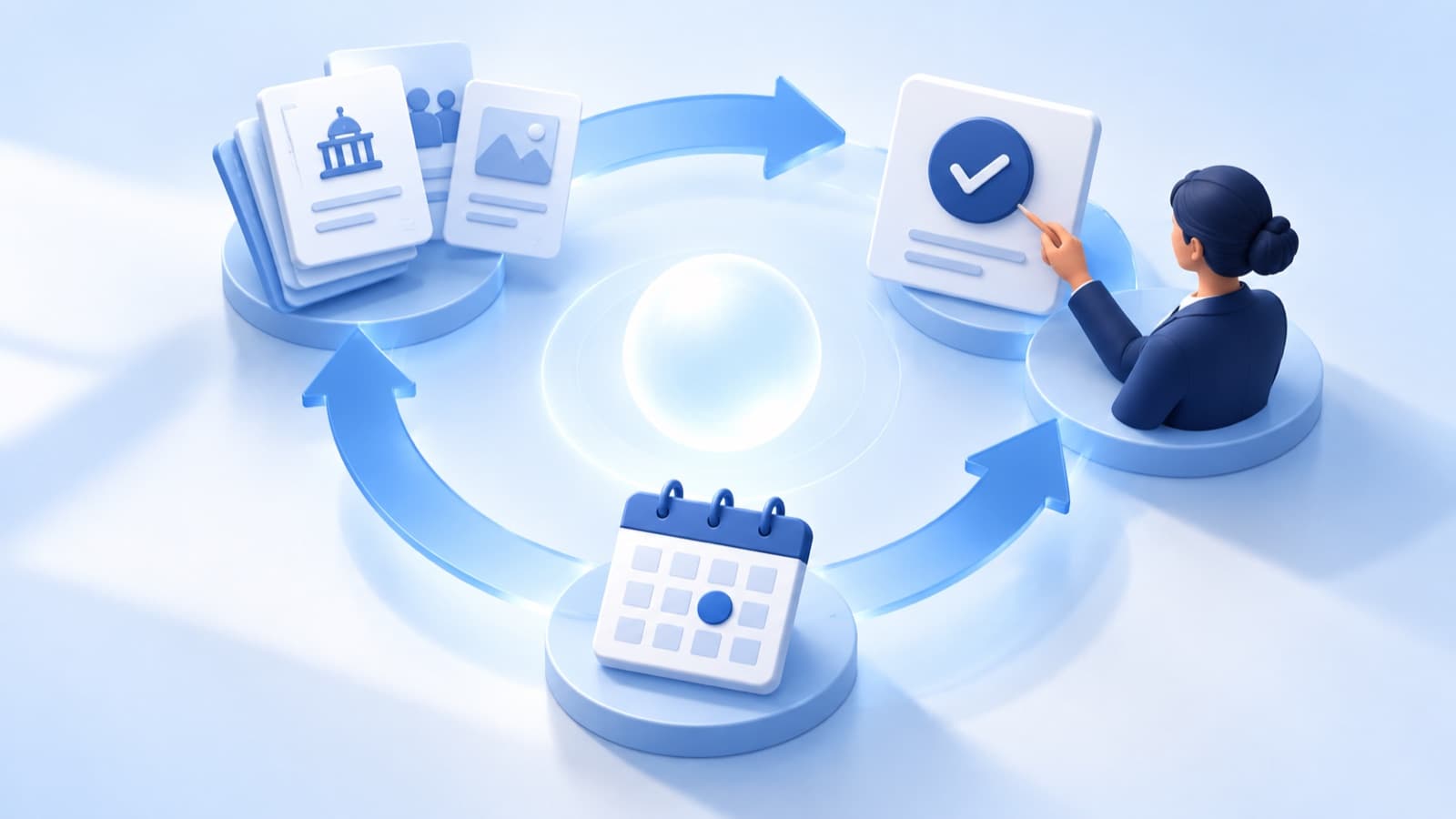
A useful government sales operating cadence closes that gap. It starts with public evidence, applies explicit fit criteria, preserves uncertainty, and ends in a human decision. The objective is not to automate judgment or manufacture certainty. It is to make the team’s judgment inspectable and timely.
The unit of work is a decision, not a signal
A signal is an observable change: a new budget proposal, an adopted appropriation, an audit finding, a public meeting item, a leadership appointment, a sources-sought notice, a contract action, or a posted solicitation. It is evidence that something happened. It is not, by itself, evidence that the agency will buy your product or that your company should pursue the account.
The federal notice sequence makes the distinction visible. SAM.gov Contract Opportunities includes pre-solicitation, solicitation, award, and sole-source notices from federal contracting offices. Those notice types describe different points in a procurement. They should not all trigger the same action. A pre-solicitation may call for validation and engagement through the stated channel; a solicitation may trigger a bid/no-bid review; an award may update incumbent and timing context.
The same discipline applies before a formal notice. The pre-RFP signals guide covers the public evidence that can reveal buyer movement earlier. The operating cadence determines which of those events deserves attention and what happens after it is found.
When the evidence becomes a posted opportunity, route it into relevant RFP discovery and qualification and then use a consistent response-readiness process. That bridge preserves the account evidence, decision rationale, and buyer context the response team would otherwise have to reconstruct.
Keep four layers separate
Every account decision should preserve four distinct layers. Collapsing them into one AI-generated sentence makes the output sound certain while hiding the assumptions a seller needs to examine.
| Layer | What it contains | Example | Control |
|---|---|---|---|
| Source | The public record or internal record, with date, URL, source type, and latest check | An agency budget proposal names funding for a case-management modernization effort | Show the record and its verification state; do not paraphrase away whether funding is proposed or adopted |
| Interpretation | Why the evidence may matter under your company’s fit criteria | The stated workflow resembles a proven use case, but the procurement path is unknown | Label inference and preserve competing explanations |
| Recommendation | The best next step given the evidence, timing, and open questions | Validate the program owner and approval path before creating an opportunity | Treat the recommendation as reviewable guidance, not an autonomous instruction |
| Human action | The commitment made by a named person, with a due date and completion record | Account owner will review the hearing packet and request a compliant discovery conversation by Friday | A person accepts, changes, or rejects the recommendation and owns the result |
Use four decision states
Every material item should leave triage in one of four states. The labels matter less than using them consistently and making the exit condition explicit.
| State | Meaning | Required fields | Exit condition |
|---|---|---|---|
| Pursue | Current evidence and fit justify active account work | Owner, decisive sources, next action, due date, stakeholder and procurement gaps | Action completed, evidence changes, or weekly review changes the decision |
| Validate | Potential fit exists, but one important claim is not confirmed | The exact question, best primary source, owner, and validation deadline | The question is answered and the account moves to pursue, watch, or pass; validate is not a permanent holding state |
| Watch | The account fits, but there is no useful action now | Reason, named trigger, source to monitor, and next review date | The trigger occurs, the review date arrives, or fit changes |
| Pass | The expected value of further attention does not justify the work | Reason, decisive evidence, decision owner, and any legitimate reopening condition | A named condition changes; otherwise the item stays out of active review |
Watch is not a polite synonym for pursue. It should consume almost no seller time until its trigger occurs. Validate is temporary: if the team cannot name the question or a credible way to answer it, move the account to watch or pass.
For a repeatable way to decide which accounts deserve the scarce pursue state, use the SLED account-prioritization template. Its score is an evidence rubric, not a win probability. The cadence is where that rubric becomes an operating choice.
The daily, weekly, and monthly cadence
Government activity does not follow a vendor’s pipeline meeting. Build the cadence around how quickly different evidence can change. New notices and agendas may require daily triage. Account strategy benefits from weekly review. Portfolio allocation and fit assumptions usually need a monthly or quarterly lens.
| Rhythm | Inputs | Decision work | Required output |
|---|---|---|---|
| Daily: triage new and changed evidence | Official notices, budget and meeting updates, contract changes, buyer or partner context, CRM activity | Deduplicate; connect the item to an account; check source and date; decide whether it changes fit, timing, or action | Pursue, validate, watch, pass, or no material change—with an owner and date where action is required |
| Weekly: review active account decisions | Open actions, fresh decisive evidence, overdue validation questions, stakeholder and procurement gaps | Confirm or change account state; clear blockers; choose the next best action; remove weak accounts from active work | A short active-account list in which every item has current evidence, one owner, and one dated next action |
| Monthly: allocate the portfolio | State changes, seller capacity, evidence freshness, action latency, account coverage, emerging segments | Compare active work with capacity; examine why decisions changed; stop low-value monitoring; adjust source coverage | Explicit investment, pause, and coverage decisions for the next month |
| Quarterly: revisit the market thesis | Observed buying paths, product and security readiness, partner performance, lost and passed decisions, changing budgets | Reassess segments, fit criteria, required proof, routes to market, roles, and tooling gaps | Documented changes to the public-sector plan and the evidence that justified them |
Daily: process changes, not the entire market
The daily loop should be narrow. Review items that are new, materially changed, due for validation, or attached to an active account. Do not ask a seller to rescan the whole database. The desired output is a small queue of exceptions that need judgment.
- Confirm the source. Open the primary record, capture its date and status, and record when it was last checked.
- Apply fit. Decide whether the event relates to the problems, buyers, security posture, contract routes, and delivery profile your team can serve.
- Name the uncertainty. Separate what the source says from what the team infers and identify the assumption that could change the decision.
- Choose a state. Pursue, validate, watch, pass, or record that the event caused no material change.
- Commit the action. A human accepts the next step, owner, and due date, or changes them with a reason.
Budget and meeting evidence illustrates why source status matters. California’s official budget-process overview distinguishes the Governor’s Budget, spring adjustments, May Revision, legislative decisions, and later administration. A proposed budget item is not enacted funding. The correct action changes as it moves through the process, and other jurisdictions use different calendars.
Public meeting sources can create shorter review windows. California’s Attorney General describes the Brown Act as a public-access law for local legislative bodies and maintains current open-meeting guidance. That does not make every agenda item a buying signal. It does make agendas, packets, minutes, and recordings valuable primary records when they concern a target account and fit your monitoring thesis.
Weekly: make account decisions in public
The weekly review is not an alert recital. Start with accounts whose evidence, state, or action changed, then inspect overdue actions and gaps across program and mission, procurement and control, and ecosystem and influence. Discuss new work last. The account owner should show the decisive source, explain the interpretation, and identify the decision needed. Close with fewer active items if the evidence warrants it.
Early federal engagement can be both useful and bounded. FAR 15.201 encourages exchanges with industry from the earliest identification of a requirement and lists techniques such as RFIs, presolicitation conferences, draft RFPs, one-on-one meetings, and site visits. It also establishes safeguards once a solicitation is issued. The weekly review should therefore ask not merely whether outreach is possible, but which channel is appropriate at the current buying stage. State and local rules must be checked in their own jurisdiction.
Monthly: decide where the team will not spend time
The monthly review reconciles ambition with capacity. Compare active accounts per owner with the research, relationship, capture, and response work they require. If the team adds an account, require a reason it outranks work already in progress—not a universal account quota.
For a leader establishing this system, the first-90-days operating plan provides the broader sequence: choose a market thesis, test it on real accounts, and operationalize only what survives the test.
Make role ownership unambiguous
Shared visibility does not mean shared accountability. Use one directly responsible person for each decision and action, while keeping specialists in the loop for the questions they are qualified to answer.
| Role | Owns | Does not own by default |
|---|---|---|
| Account owner | The pursue, validate, watch, or pass decision; stakeholder plan; accepted next action and due date | Unreviewed recommendations made by a feed or model |
| Research or intelligence | Source coverage, entity matching, evidence quality, dates, verification state, and material-change summary | The commercial pursue decision or relationship action |
| Capture or proposal | Procurement interpretation, bid/no-bid inputs, response plan, requirements traceability, and grounded response work | Broad territory prioritization outside agreed criteria |
| Executive sponsor | Tradeoffs involving capacity, risk, compliance investment, partnerships, and strategic exceptions | Routine triage that the operating system should resolve |
| Partner or reseller | The context, access, contract route, or delivery responsibility explicitly agreed with your team | Your account strategy, source of truth, or final qualification decision |
The account owner may accept a recommended next action, edit it, or reject it. The important behavior is that the choice is explicit. Automatic owner assignment or outreach can move fast while moving in the wrong direction; a government sales system should reduce the cost of judgment without pretending judgment has disappeared.
Measure the operating system, not the size of the feed
Alert count, records indexed, and searches run describe system activity. They do not show whether the team is making better decisions. Establish a baseline for the measures below, then improve the trend. Do not borrow a universal benchmark from a company with different coverage, cycle length, and staffing.
| Metric | How to define it | Question it answers |
|---|---|---|
| Decision coverage | Share of reviewed material items with an explicit state and reason | Are signals becoming decisions or accumulating as unread work? |
| Evidence freshness | Age and latest-check status of the sources that materially support active decisions | Are we acting on current evidence or an old assumption? |
| Decision latency | Elapsed time from a material source change to the recorded human decision | Can the team respond while the evidence is still useful? |
| Action integrity | Share of pursue and validate items with one named owner, due date, and completion or change reason | Does priority translate into accountable work? |
| Stakeholder-lane coverage | Active accounts with program and mission, procurement and control, and ecosystem and influence paths identified, with unknowns recorded | Are we building a buying map or depending on one contact? |
| Decision reversals with evidence | State changes that cite a new public or internal fact and explain the reasoning | Is the team learning, or merely changing labels? |
A short evaluation should test these mechanics before claiming business impact. The public-sector pilot scorecard explains how to set a 30–45 day baseline and review decision quality without tying a tool evaluation to an eventual contract win.
Where tooling should—and should not—fit
Portals and public records expose official events. GovWin-class market intelligence can add procurement history, forecasts, and analyst context. Partners and resellers can add access or a contract route. CRM preserves account, relationship, and pipeline context. None should be casually discarded simply because the team adds a signal workflow.
The useful layer between those systems applies company-specific fit, connects a signal to the right account, preserves the latest source check and recorded verification state, adds buyer and stakeholder context, and recommends what a person might do next. It should also carry grounded evidence forward when the team begins response work.
That is the role Settle is designed to play. It is additive to source systems and CRM. It does not claim that every public fact is universally verified, assign owners or send outreach without human judgment, produce a calibrated win probability, or guarantee an outcome. See how Settle connects source-backed buying signals to action.
Start with a small active account set, publish the four decision states, create one evidence record, and run a weekly review that discusses changed decisions before new alerts. A good cadence should make the feed feel smaller. The team understands why the remaining evidence matters and begins the day with a defensible next action. That is the difference between intelligence that informs work and another database to doom-scroll.
Frequently asked questions
What is a government sales operating cadence?
It is the repeatable process that turns a sourced change in a public account into a human-reviewed pursue, validate, watch, or pass decision. Every active decision carries its evidence, a named owner, and a dated next action.
How often should a public-sector sales team review signals?
Triage new or materially changed evidence daily, review active account decisions weekly, allocate the portfolio monthly, and revisit market-fit assumptions quarterly. Adjust the rhythm to source timing, seller capacity, and jurisdiction; the goal is timely decisions, not constant monitoring.
Who owns a government buying signal?
Research or intelligence can own source quality and verification state, but the account owner should own the commercial decision and accepted next action. A feed or model can recommend an action; a named person must accept, modify, or reject it.
What is the difference between a signal and an opportunity?
A signal is evidence that something changed, such as a budget action, audit, appointment, meeting item, contract event, or notice. An opportunity is a sales judgment supported by fit, timing, a plausible buying path, and sufficient evidence. Not every signal should become an opportunity.
Which metrics should a government sales team track before revenue?
Start with decision coverage, freshness of decisive evidence, time from material change to human decision, ownership and due-date integrity, and stakeholder-lane coverage. Establish your own baseline and improve it; do not treat alert volume or an arbitrary industry benchmark as proof of value.
Does a signal platform replace SAM.gov, state portals, market intelligence, or CRM?
It should not need to. Official portals and records remain sources, market-intelligence tools add context, partners add access or contract routes, and CRM preserves relationship and pipeline context. The signal workflow should connect those systems to fit, evidence, a decision, and the next action.