The Hidden Cost of Manual RFPs in 2026 (and What You Can Do About It)
by
Alex
Nikanov
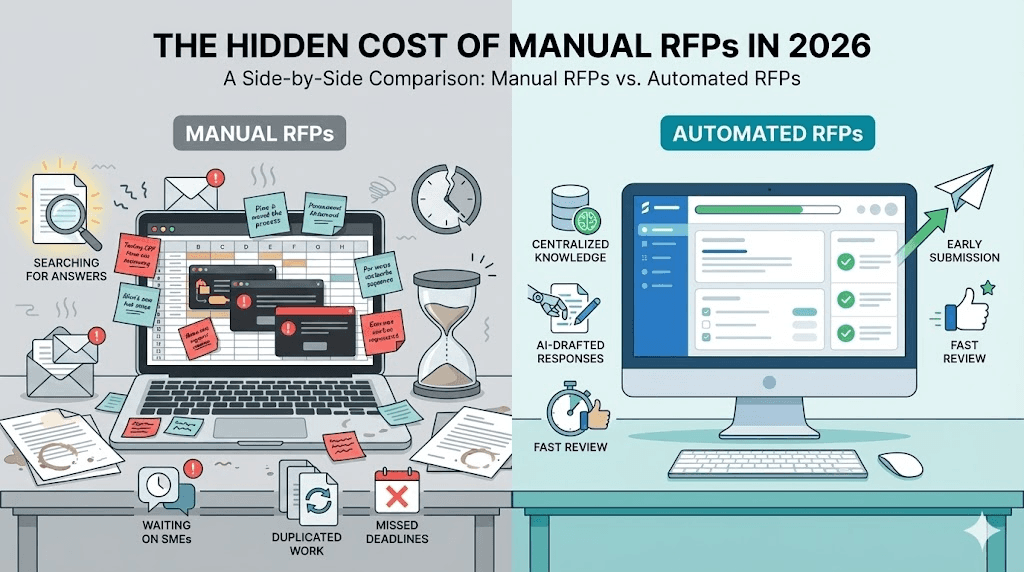
It’s January 2026, and every sales and proposals team is setting goals: higher win rates, shorter cycles, more time selling, not answering questions. Yet across industries, one recurrent blocker remains: manual RFP response work.
It’s tedious, inefficient, and expensive. If your team hasn’t quantified the real impact of manual RFPs on time, revenue, and wins — now’s the moment to do that. This post breaks down where the hidden costs lie and how RFP automation lets teams reclaim hours, improve quality, and actually move business forward.
1) Manual RFP Work Isn’t Just Slow — It’s Business Drag
Most teams treat RFPs as a necessary evil — a few tedious hours here and there. But collectively, it adds up:
Labor time:
A typical RFP can easily require dozens of person-hours across sales, product, legal, and operations. Those hours are billable or strategic time lost.Coordination overhead:
Hunting answers in shared drives, Slack threads, Notion pages, or stale documents not only delays responses — it increases error risk.Opportunity cost:
Slow turnaround means:missed deadlines
delayed proposals
lost revenue
and lower win rates
All because the team is swamped with formatting and searching instead of selling.
These aren’t hypothetical. They’re real costs that weigh down pipeline velocity every quarter.
2) Manual Workflow Hurts Your Win Rate (More Than You Think)
Responding slowly or inconsistently impacts evaluators’ perception of your offering. When your answers are late, generic, or full of placeholders like “TBD,” it signals lack of preparation or capability. That’s a hard hill to climb once an evaluator doubts your reliability.
On the flip side, teams that submit early and with high-quality, tailored content are perceived as:
more professional
more capable
easier to partner with
Every hour shaved off response time can translate into a stronger pitch, which improves your odds of getting a yes.
3) Automation Isn’t Optional — It’s a 2026 Must
Automating RFP responses doesn’t mean removing humans — it means:
centralizing approved answers
reusing high-quality content
auto-drafting tailored responses
enabling fast review and collaboration
When you eliminate repetitive work, your team spends more time where it matters:
strategic positioning
competitive differentiation
deal strategy
This shift from busy work to high-impact work isn’t just a productivity boost — it’s a competitiveness multiplier.
4) What Automation Actually Moves for Teams
Let’s make this real with an actual customer outcome.
Crafty: From Weeks of Work to Hours of Impact
Before Settle, Crafty’s sales team faced a tidal wave of enterprise RFPs, each hundreds of questions deep. Multiple people had to track down answers from disorganized sources, chase subject matter experts, and manually assemble responses — a process that took weeks.
After adopting Settle’s AI-powered RFP automation:
Time to submit dropped by 80%
Handled RFP volume increased 3×
Sales reps spent more time selling and less on repetitive work
Quality and consistency of responses improved, boosting deal competitiveness
As Jordan Christopher, SVP of Sales at Crafty put it:
“Before Settle, RFPs were incredibly disruptive. They took weeks and drained the team. Now, Crafty’s sales org answers complex questionnaires in hours. We can handle more volume while improving the quality and consistency of our submissions, which is allowing us to win more deals.”
This kind of result isn’t a fringe benefit — it’s what successful 2026 planning looks like.
Read the full case study here.
5) Your 2026 RFP Automation Planning Checklist
Here’s a quarter-by-quarter guide to move from manual churn to automated flow:
🔹 Q1 — Benchmark & Baseline
Measure current RFP turnaround times
Audit where time is spent (searching, writing, reviewing)
Identify content gaps and inconsistent responses
🔹 Q2 — Evaluate Tools & Pilot Automation
Test tools that centralize library + AI drafting
Run pilots on select RFPs
Gather before/after performance data
🔹 Q3 — Full Implementation & Training
Roll out to all proposal contributors
Implement review workflows
Set response time targets (e.g., <48 hours)
🔹 Q4 — Optimize & Measure Wins
Analyze win rates, volume capacity, human time freed
Refine content libraries and reuse patterns
Forecast automation ROI for next year
This structure turns a perennial headache into a measurable part of your revenue strategy.
6) Measure What Matters — The Real KPIs
If you want buy-in from leadership, frame your impact around metrics they care about:
Hours saved per RFP
Increase in RFP capacity
Improvement in win rate
Reduction in cross-team coordination time
Faster deal cycle close
By tracking these, you turn RFP automation from a “nice to have” into a revenue driver.
Conclusion — Your Calendar Is Running
2026 planning is already underway. If manual RFP responses are still dragging your team into inefficient workflows, that’s lost opportunity, not just frustration. Teams that automate not only reclaim hours — they sharpen their competitive edge.
Start your year by measuring the real cost of your RFP process, set clear goals against it, and choose tools that help you win faster and stronger.
——
Ready to shift from weeks of busywork to hours of impact?
Get a free demo of Settle and see how fast you can turn RFPs into wins.
👉 Get Demo