Unlocking Your Local Revenue: A Guide to Municipal RFPs
Feb 10, 2026
The Local Opportunity: Why Municipal Bidding Matters
For many growing businesses, local government contracts represent the ultimate stabilizer. Unlike the volatile commercial sector, municipal agencies—cities, counties, school districts, and transit authorities—operate on set budgets and multi-year cycles. Securing a spot as a preferred vendor provides a predictable revenue stream. However, the barrier to entry often feels high due to the complexity of the Request for Proposal (RFP) process.
A Request for Proposal (RFP) is a formal document issued by a government entity that outlines a project's requirements and invites vendors to submit competitive bids. In the municipal space, these can range from infrastructure repairs and IT services to specialized consulting. While the rewards are significant, the sheer volume of paperwork and the rigid deadlines can overwhelm even the most experienced sales teams.
The Challenge of Fragmented Discovery
One of the biggest hurdles in winning local government contracts is simply finding them. Unlike federal contracts, which are largely centralized, municipal opportunities are scattered across thousands of individual city and county procurement portals. If you are manually checking twenty different websites every Tuesday, you are already behind the curve. By the time a high-fit RFP is found, the deadline is often less than two weeks away.
This is where modern technology changes the game. Systems like RFP Hunter by Settle act as an automated discovery engine, aggregating active municipal RFPs into a single, searchable feed. Instead of hunting, you receive high-fit opportunities filtered by category and location, allowing you to focus your energy on the actual response rather than the search.
Building Your Single Source of Truth
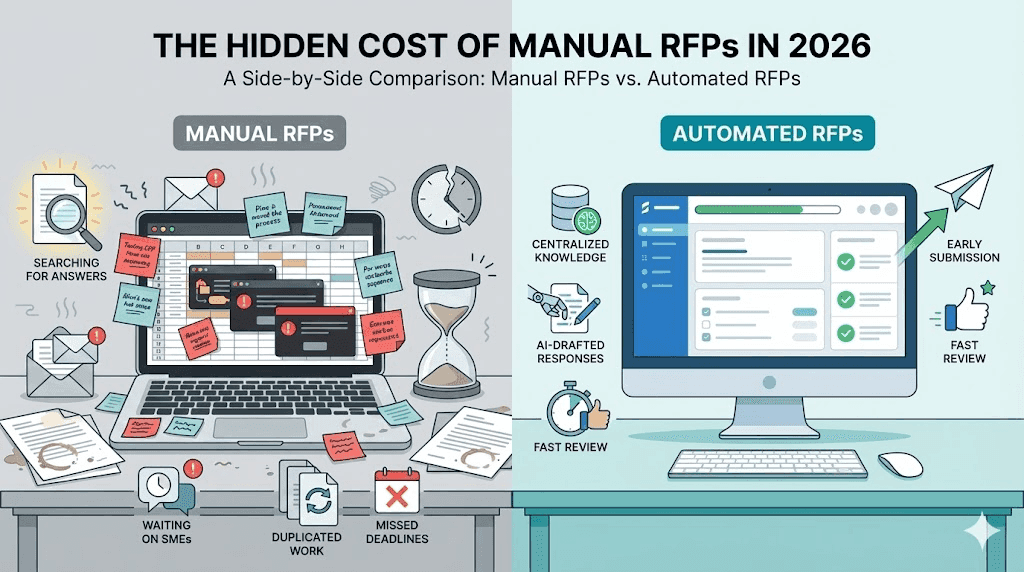
Every municipal RFP asks the same core questions: What is your past performance? What are your safety protocols? How do you handle data privacy? For many teams, the answers to these questions are buried in old Word documents or the sent folders of a former employee’s inbox. This fragmented knowledge leads to inconsistent answers and massive time waste.
A Centralized Proposal Knowledge Base serves as your company’s internal Wikipedia. By ingesting past PDFs, spreadsheets, and CSV files, you create a Library that serves as the foundation for every future bid. When a new municipal RFP lands on your desk, you are no longer starting from a blank page. You are building on a foundation of approved, verified data.
Reducing Friction with AI-Powered Drafting
The technical drafting phase is often the longest part of the bid lifecycle. A standard city contract may require forty pages of documentation. Research shows that pre-sales and proposal teams spend 60% of their time on repetitive tasks, such as re-typing company bios or re-explaining service methodologies.
Automation tools like Settle use AI to draft responses grounded exclusively in your approved Library content. By bulk-generating answers that match the specific context of the municipal RFP, teams can cut their response time by as much as 80%. This speed doesn't just save labor costs; it allows you to increase your bid volume without adding more headcount.
Ensuring Compliance Through Structured Review
In local government, a single missing signature or a skipped technical requirement can lead to immediate disqualification. Competition is fierce, and municipal reviewers often use a scoring rubric where every point counts. Collaboration becomes critical here. You need the technical lead to verify the specs, the CFO to approve the pricing, and the legal team to sign off on the terms.
Email threads are where great proposals go to die. Using a dedicated Project workspace with an Inbox for task management ensures that every reviewer knows exactly what they need to do and when. Structured review workflows ensure that no question goes unanswered and no requirement is overlooked, giving small teams the ability to compete at an enterprise scale.
But here is the thing: the goal isn’t just to submit more bids. It is to submit better ones. By automating the repetitive elements of the municipal RFP, your team gains the white space needed to focus on strategy, tailored messaging, and building a persuasive case for why the city should choose you. Tools like Settle help automate this process, turning a stressful sprint into a repeatable system for growth.
Frequently Asked Questions
What is the difference between an RFP and an RFQ in municipal procurement?
A Request for Proposal (RFP) is used when the local government has a problem and is looking for a solution, focusing heavily on the vendor's methodology, experience, and technical approach alongside price. A Request for Quotation (RFQ) is typically used for standardized goods or commodities where the requirements are already defined and the decision is primarily based on the lowest price. Understanding this distinction helps teams decide whether to highlight their innovative expertise or their operational efficiency.
How can a small business find local government contracts effectively?
Small businesses can find municipal opportunities by using automated discovery tools like Settle’s RFP Hunter, which aggregates bids from various local portals into one view. They should also register as a vendor in the specific procurement systems of their target cities and counties to receive direct notifications. Many local governments also have 'Small Business Enterprise' (SBE) or 'Minority/Woman-Owned Business Enterprise' (MWBE) programs that offer specific set-asides or scoring advantages for certified firms.
Why is a centralized knowledge base important for municipal bidding?
Municipal RFPs often contain repetitive administrative and technical questions that require consistent answers to maintain compliance and professional credibility. A centralized knowledge base, or Library, acts as a single source of truth that stores approved responses from previous successful bids, ensuring that the team doesn't have to reinvent the wheel for every submission. This reduces the risk of human error and allows for much faster drafting of complex documents.
Can AI help with the compliance requirements of government contracts?
Yes, AI can significantly assist with compliance by automatically extracting questions from dense RFP documents and matching them against a verified library of past answers. Professional tools like Settle also allow for 'Smart Answers' that are grounded only in your approved data, preventing the AI from 'hallucinating' or making up facts. This ensures that every technical response accurately reflects your company’s capabilities while adhering to the specific constraints of the government’s request.
How does collaboration software improve the win rate for RFPs?
Collaboration software improves win rates by centralizing the review process, allowing subject matter experts (SMEs) to Provide input directly within the proposal document rather than through disconnected email threads. This ensures higher accuracy in technical responses and prevents bottlenecks that lead to rushed, lower-quality submissions at the last minute. By using structured workflows and clear assignments, the team can ensure multiple rounds of quality control, which is often the difference between a winning score and a runner-up finish.